How Do Satellites Stay in Orbit? The Simple Physics of Never Falling Down
- Primary Signal: How Do Satellites Stay in Orbit? The Simple Physics of Never Falling Down
- Overview: Satellites are always falling — they just keep missing the Earth. Learn the simple physics behind orbits, why altitude matters, and what eventually brings them down....
- Verification: Analyzed and compiled by FreeSky Aerial editorial monitoring desk.
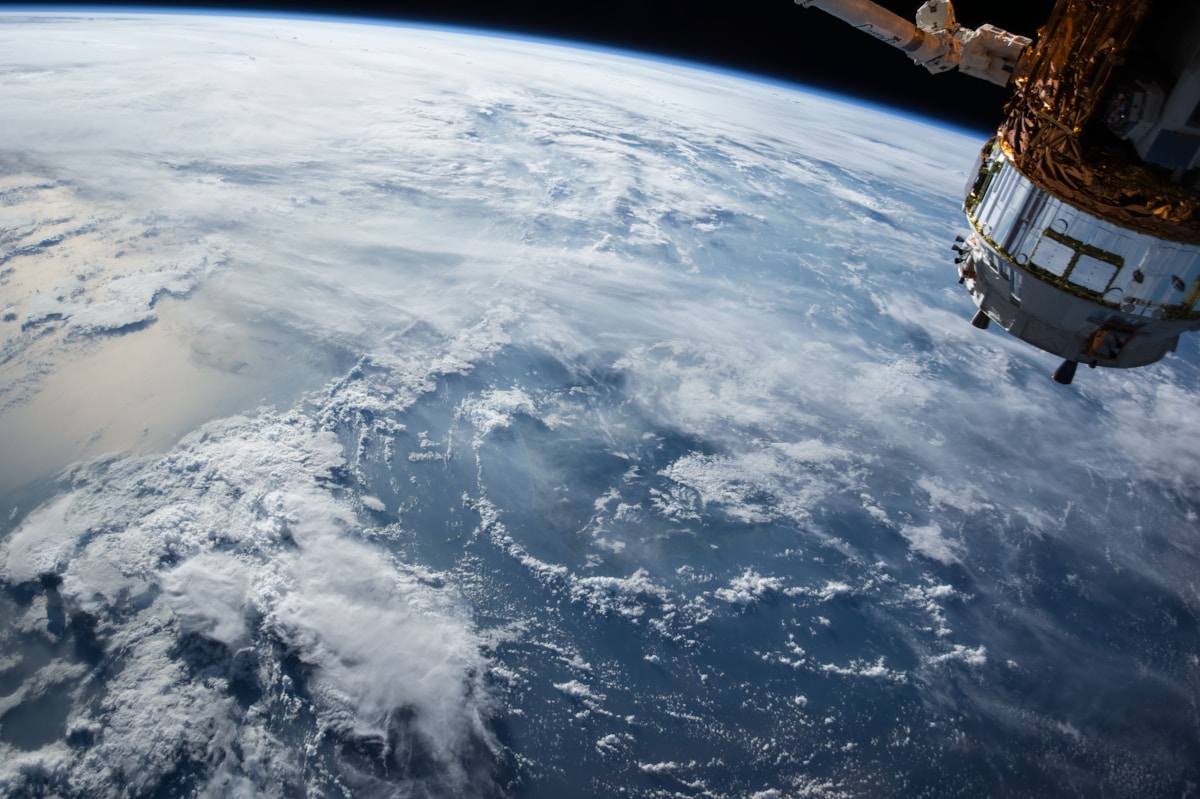
A satellite stays in orbit through a beautiful trick: it is always falling toward Earth, but it is moving sideways so fast that it keeps missing. This is not a metaphor. Orbit is continuous freefall, aimed so precisely that the curve of the fall matches the curve of the planet. Once you see it this way, satellites stop being mysterious.
Imagine throwing a ball. It arcs and lands nearby. Throw it harder and it lands further away. If you could throw it fast enough — about twenty-eight thousand kilometres per hour — the ball would fall toward Earth at exactly the rate the surface curves away beneath it. It would never land. That is an orbit, and satellites are simply balls thrown that hard.
Altitude decides the speed. A satellite close to Earth, a few hundred kilometres up, must travel very fast to stay in orbit, circling the planet roughly every ninety minutes. A satellite much further out can move more slowly, because gravity is weaker there. This is why the International Space Station laps the planet sixteen times a day, while a weather satellite can hover over one spot.
That hovering trick deserves its own explanation. A satellite placed about thirty-six thousand kilometres above the equator takes exactly twenty-four hours to complete one orbit — the same time Earth takes to rotate once. From the ground, it appears to hang motionless in the sky. This geostationary orbit is why satellite TV dishes can point at a fixed spot and never move.
Orbits are not perfectly stable, and that is why satellites carry fuel. The thin atmosphere at low altitudes creates drag that slowly pulls satellites down. The Sun and Moon tug at them gravitationally. Ground teams use small thruster burns to correct the drift, keeping the satellite in its assigned slot for years or decades.
Eventually, every satellite runs out of fuel or outlives its purpose, and then the orbit decays. Low satellites burn up in the atmosphere, which is a clean ending. Higher satellites are pushed into a graveyard orbit, a quiet zone hundreds of kilometres above the working satellites, where they will drift harmlessly for centuries.
Most working satellites live in one of three orbital neighborhoods. Low Earth orbit, a few hundred to two thousand kilometres up, hosts the space station, Earth observation satellites, and the new mega-constellations for internet service. Medium Earth orbit, around twenty thousand kilometres up, is home to navigation satellites like GPS, which need a wide view of the planet. Geostationary orbit, thirty-six thousand kilometres above the equator, hosts communications and weather satellites that must stay fixed over one region.
Each orbit is a trade-off. Lower orbits give sharper images and lower signal delay, but satellites there move fast and need many of them for continuous coverage. Higher orbits cover huge areas with few satellites, but the signal takes longer and the launch costs more. The satellite networks we rely on daily are designed around these trade-offs, mixing orbits the way a transport system mixes local roads and highways.
The next time you use GPS, check the weather, or watch satellite television, remember the trick behind it: thousands of machines, all falling around the Earth, missing it perfectly, lap after lap. Orbit is not about escaping gravity. It is about using gravity, at exactly the right speed, to fall forever.
You can see this physics with your own eyes on a clear evening: bright satellites, including the space station, glide steadily across the sky, neither climbing nor falling. They are falling, continuously, around a curving Earth — and that endless, precise fall is what keeps our connected world running, day and night, without pause.
📖 Continue Reading the Full Story
Continue reading this article on FreeSky Aerial.
⚡ Access Full Content NowMore from FreeSky Aerial



 🗺️ FreeSky GeoData
Technical Breakdown: Freelancer Net Pay Calculator (PKR) — Upwork, Fiverr & Payoneer Fees (Day 14 Guide)
Architectural examination of our Freelancer Net Pay Calculator (PKR) — Upwork, Fiverr & Payoneer Fees on FreeS...
⚡ CyberTech 568
Step-by-Step Tutorial: Palworld Breeding Calculator — Parents, Combos & Paths (Day 2 Guide)
How to accurately use the Palworld Breeding Calculator — Parents, Combos & Paths on CyberTech 568. Discover es...
 🤖 WinBar AI
Instagram Reels Downloader for PC: Save Reels Free Online
Download Instagram Reels to your PC free — no app, no login. Paste the reel link and save in HD quality straig...
 ☁️ FreeSky Cloud
ROI & Value Audit: GST Calculator — Add or Extract GST & VAT (Day 15 Guide)
How to save time and eliminate guesswork with GST Calculator — Add or Extract GST & VAT on FreeSky Cloud. Disc...