NASA estudará saúde humana e desempenho durante a missão Crew-13
Story summary
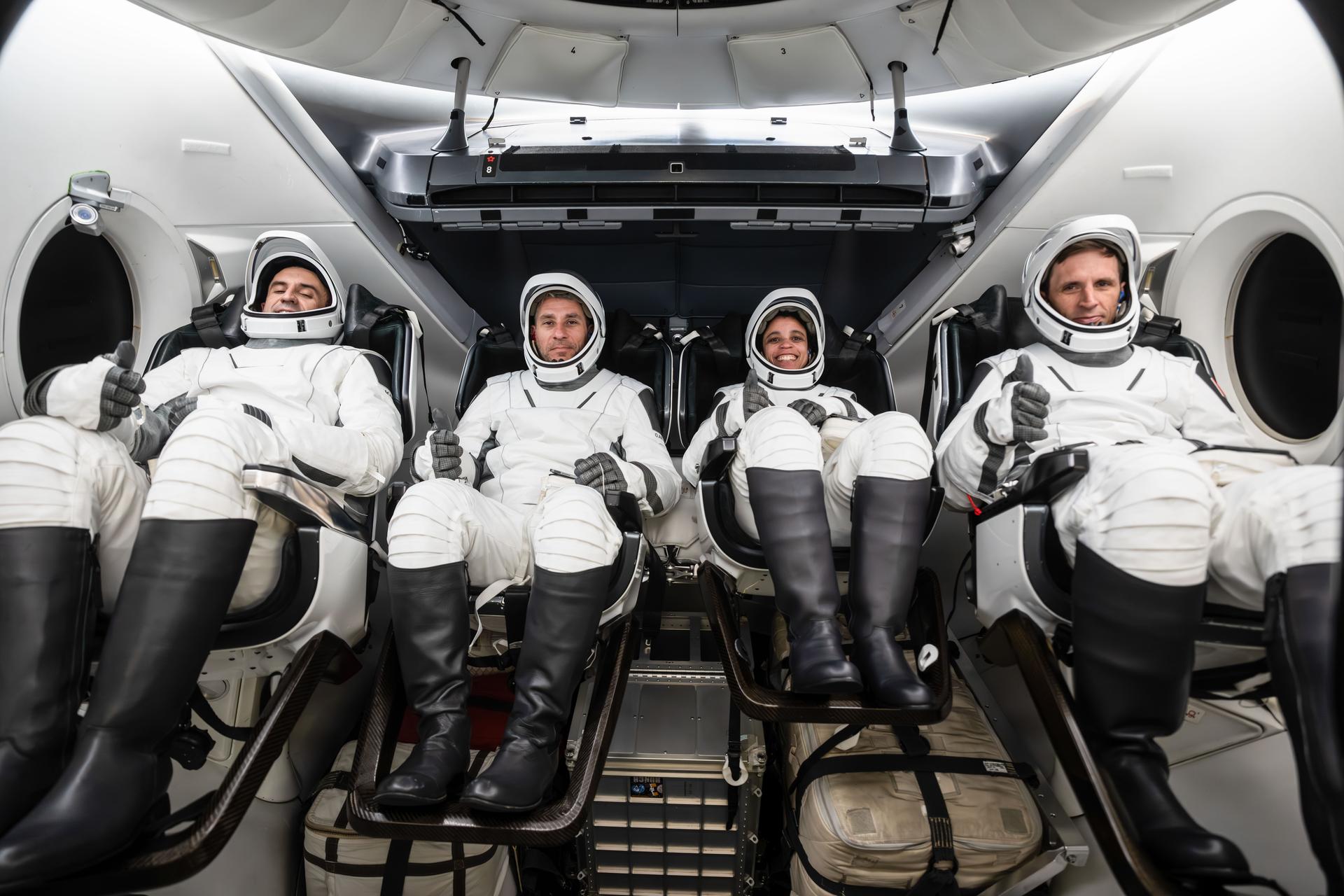
Durante a missão SpaceX Crew-13 da NASA a bordo da Estação Espacial Internacional, os astronautas apoiarão uma série de investigações biomédicas e de desempenho humano, incluindo um novo esforço colaborativo para estudar como o voo espacial afecta o fluxo sanguíneo e a coagulação. A NASA também está testando o manual dos tripulantes
📌 Key Highlights & Takeaways
- Durante a missão SpaceX Crew-13 da NASA a bordo da Estação Espacial Internacional, os astronautas apoiarão uma série de investigações biomédicas e de desempenho humano, incluindo um novo esforço colaborativo para estudar como o voo espacial afecta o fluxo sanguíneo e a coagulação.
- A NASA também está testando o manual dos tripulantes
During NASA’s SpaceX Crew‑13 mission aboard the International Space Station, astronauts will support a series of biomedical and human performance investigations, including a new collaborative effort to study how spaceflight affects blood flow and clotting. NASA also is testing crew members’ manual piloting skills, evaluating methods to counter vision and brain changes, gathering essential health data to inform future missions, and measuring forces astronauts experience during return‑to‑Earth to help refine re-entry hardware and procedures.
Among upcoming research, a new collaboration with ESA (European Space Agency), called Venous Haemostasis , builds on previous studies of blood flow in space by combining the two space agencies’ research efforts. By coordinating blood collections and other physiological data, researchers can reduce how often astronauts need blood drawn while combining analytical measurements to better understand how microgravity affects blood clotting and circulation.
“In space, weightlessness can disrupt normal blood flow in astronauts’ veins,” said Jason Lytle, one of the study’s principal investigators and a cardiovascular researcher at NASA’s Johnson Space Center in Houston. “Irregular and slow blood flow can increase the risk of blood clot formation, a serious health condition. Venous Haemostasis will help us understand why these changes may occur in some astronauts but not others.”
Before, during, and after flight, astronauts will undergo MRI scans, jugular vein ultrasounds, blood pressure checks, and blood draws so researchers can track changes in blood flow and blood composition. Results will inform preventative measures for at-risk crew members and improve health and safety on future missions. Researchers also hope to learn whether knowledge gained from this and other studies may lead to better ways to prevent and treat blood clots both in space and on Earth.
A performance study, called Manual Piloting , uses lunar-landing simulations to test how well astronauts can handle challenging landings after spending extended time in microgravity. Because long-duration spaceflight can affect sensory systems, orientation, and motion control during shifts between gravity environments, researchers are evaluating how those changes influence piloting performance and whether refresher training shortly before landing can strengthen capabilities and decision-making.
Researchers also will continue the B-Complex study , which investigates if a daily B-vitamin supplement can reduce or prevent Spaceflight-Associated Neuro-ocular Syndrome (SANS) , a condition that can change astronauts’ eye structure during long-duration missions. Past research suggests taking B vitamins daily during spaceflight may help protect astronauts from SANS. Participating crew members will undergo vision tests and take B vitamins before, during, and after flight to evaluate the supplement’s effectiveness. The study also will assess whether the B vitamins influence how crew members’ blood vessels function before and after flight.
Select Crew-13 astronauts also will participate in three additional Human Research Program studies: Standard Measures, Spacecraft Occupant Risk, and Zero T2. Standard Measures collects consistent physiological and behavioral data from as many crew members as possible to establish baselines for research aimed at countering adverse effects. Spacecraft Occupant Risk characterizes the forces astronauts experience during landing to help NASA refine strategies and hardware to reduce injury risks. Zero T2 tracks the exercise routines of select crew members to compare health and performance data between astronauts who use the treadmill for aerobic exercise aboard station and those who do not. The comparisons will help researchers build exercise plans for future Artemis and deep-space missions, where spacecraft size could limit or eliminate treadmill use.
“Together, these investigations will help NASA better understand how the human body responds to spaceflight and whether specific strategies can effectively protect astronaut health and performance,” said Michael Stenger, Human Research Program chief scientist at NASA Johnson. “Knowledge gained will pave the way for NASA’s efforts to safely send humans farther into the solar system, including Artemis missions to the Moon, work on the Moon Base, and future expeditions to Mars.”
Editorial Text & Content Analyzer
Analyze real-time word count, reading speed, and text density metrics on the fly.
Source: NASA.
Read the full story at the original source ↗
For questions: mrsmithcons@gmail.com.
Stunning 4K Uncompressed Drone Footage, Aviation Telemetry & Orbital Launch Broadcasts
Immerse yourself in spectacular aerial perspectives: ultra-high-definition 4K drone cinematography, aerospace breakthroughs, and orbital launch telemetry.
Watch 4K Aerials ➔🎬 High-Bitrate Master Footage & Flight Telemetry
Uncompressed 4K aerial recordings, GPS flight logs, and camera profiles.
⚡ Stream Master Video NowMore from FreeSky Aerial

 🔭 FreeSky Cosmos
NASA Selects Far-Infrared Telescope as First in New Mission Class
NASA announced Wednesday a mission to explore the history and evolution of the universe, PRIMA (PRobe far-Infr...
Albanese says OpenAI hacked government health website in 'obviously unacceptable' breach
Albanese says OpenAI hacked government health website in 'obviously unacceptable' breach OpenAI did not raise ...
 🗺️ FreeSky GeoData
Autonomous Drone Fleet Mapping & Topographic Modeling in 3D Photogrammetry
Comprehensive 2026 research dossier and telemetry report on Autonomous Drone Fleet Mapping & Topographic Model...
 🤖 WinBar AI
Como as operadoras podem aproveitar a IA agente nas apostas esportivas
Cobertura de última hora relatada pela iGaming Business: Como as operadoras podem aproveitar a IA da agência e...