NASA-Modellflügel leuchtet bei ersten druckempfindlichen Lacktests auf
Story summary
Bahnbrechende Tests im Langley Research Center der NASA in Hampton, Virginia, ebnen den Weg für neue Windkanalmöglichkeiten für die Entwicklung der Flugzeugtechnologien der Zukunft. In einem einzigartigen Test im Transonic Dynamics Tunnel der NASA Langley verwendeten Forscher instationäre Drucksensoren
📌 Key Highlights & Takeaways
- Bahnbrechende Tests im Langley Research Center der NASA in Hampton, Virginia, ebnen den Weg für neue Windkanalmöglichkeiten für die Entwicklung der Flugzeugtechnologien der Zukunft.
- In einem einzigartigen Test im Transonic Dynamics Tunnel der NASA Langley verwendeten Forscher instationäre Drucksensoren
Groundbreaking tests at NASA’s Langley Research Center in Hampton, Virginia, are paving the way for new wind tunnel capabilities for designing the aircraft technologies of the future.
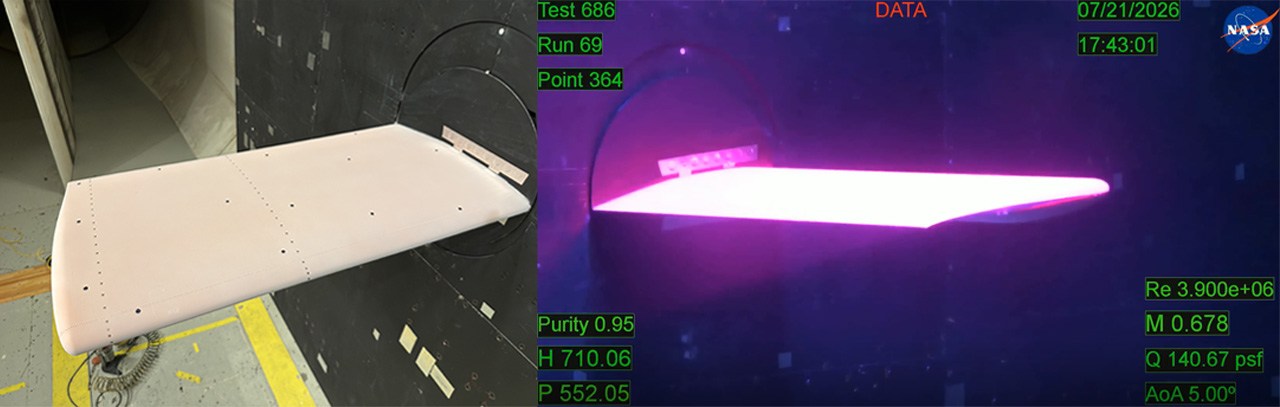
In a first-of-its-kind test in NASA Langley’s Transonic Dynamics Tunnel, researchers used unsteady Pressure Sensitive Paint to study how air flows around a standard wind tunnel model known as the Benchmark Supercritical Wing. As the team observed the test, the paint’s special capabilities made the model wing glow pink-purple when exposed to special ultraviolet lights, while high-speed cameras captured every detail.
The test combined two valuable NASA tools. NASA’s benchmark wings don’t represent a particular type of aircraft, rather they are meant as universal models to help researchers improve computer modeling using wind tunnel data.
Unsteady pressure sensitive paint is a specialized coating that varies in brightness according to how much pressure the air flow applies to the wing. High-speed cameras capture those changes, providing data for computer models. For years, NASA researchers at centers including Langley and the agency’s Ames Research Center in California’s Silicon Valley have been working to integrate the paint into wind tunnel tests for aircraft and rockets. NASA researchers consider the paint a vital tool and expect to find many more wind tunnel applications in the future.
This test marked the technique’s first use on a large-scale, freely moving model in a low‑oxygen environment, an achievement made possible by the Transonic Dynamic Tunnel’s unique testing capabilities.
This milestone opens the door for upcoming tests on flexible aircraft models that are designed to bend and adapt during flight to improve efficiency. It also lays the foundation for better simulations and designs as NASA advances the future of flight.
Editorial Text & Content Analyzer
Analyze real-time word count, reading speed, and text density metrics on the fly.
Source: NASA.
Read the full story at the original source ↗
For questions: mrsmithcons@gmail.com.
🎬 High-Bitrate Master Footage & Flight Telemetry
Uncompressed 4K aerial recordings, GPS flight logs, and camera profiles.
⚡ Stream Master Video NowMore from FreeSky Aerial
 🗺️ FreeSky GeoData
Autonomous Drone Fleet Mapping & Topographic Modeling in 3D Photogrammetry
Comprehensive 2026 research dossier and telemetry report on Autonomous Drone Fleet Mapping & Topographic Model...
 🤖 WinBar AI
Woche 4 NFL-Wetten, Quoten: Tipps gegen den Spread, Gewinner für jedes Spiel aus einem gemischten KI-Modell
Aktuelle Berichterstattung von Yahoo Sports: Woche 4 NFL-Wetten, Quoten: Tipps gegen die Spanne, Gewinner für ...
 🔭 FreeSky Cosmos
What’s Up: October 2026 Skywatching Tips from NASA
A Meteor Shower and the Moon Near the Pleiades See Saturn at opposition, catch the Orionid meteor shower, and ...
Inside Soitec, the French tech company powering the global semiconductor industry
Inside Soitec, the French tech company powering the global semiconductor industry From smartphones to data cen...